 Loading... Please wait...
-
Call us on (973) 810-2976
- My Account
- Gift Certificates
- Items / $0.00
All prices are in All prices are in USD
Categories
- Home
- Identified Artifacts
- Revolutionary War Keg/Canteen with “E.G”, for “Ewings Guard”
- Home
- Non-excavated Artifacts
- Revolutionary War Keg/Canteen with “E.G”, for “Ewings Guard”
- Home
- Personal Items
- Revolutionary War Keg/Canteen with “E.G”, for “Ewings Guard”
- Home
- Late 18th Century / Early 19th Century
- Revolutionary War Keg/Canteen with “E.G”, for “Ewings Guard”
- Home
- Revolutionary War items
- Revolutionary War Keg/Canteen with “E.G”, for “Ewings Guard”


Revolutionary War Keg/Canteen with “E.G”, for “Ewings Guard”

Product Description
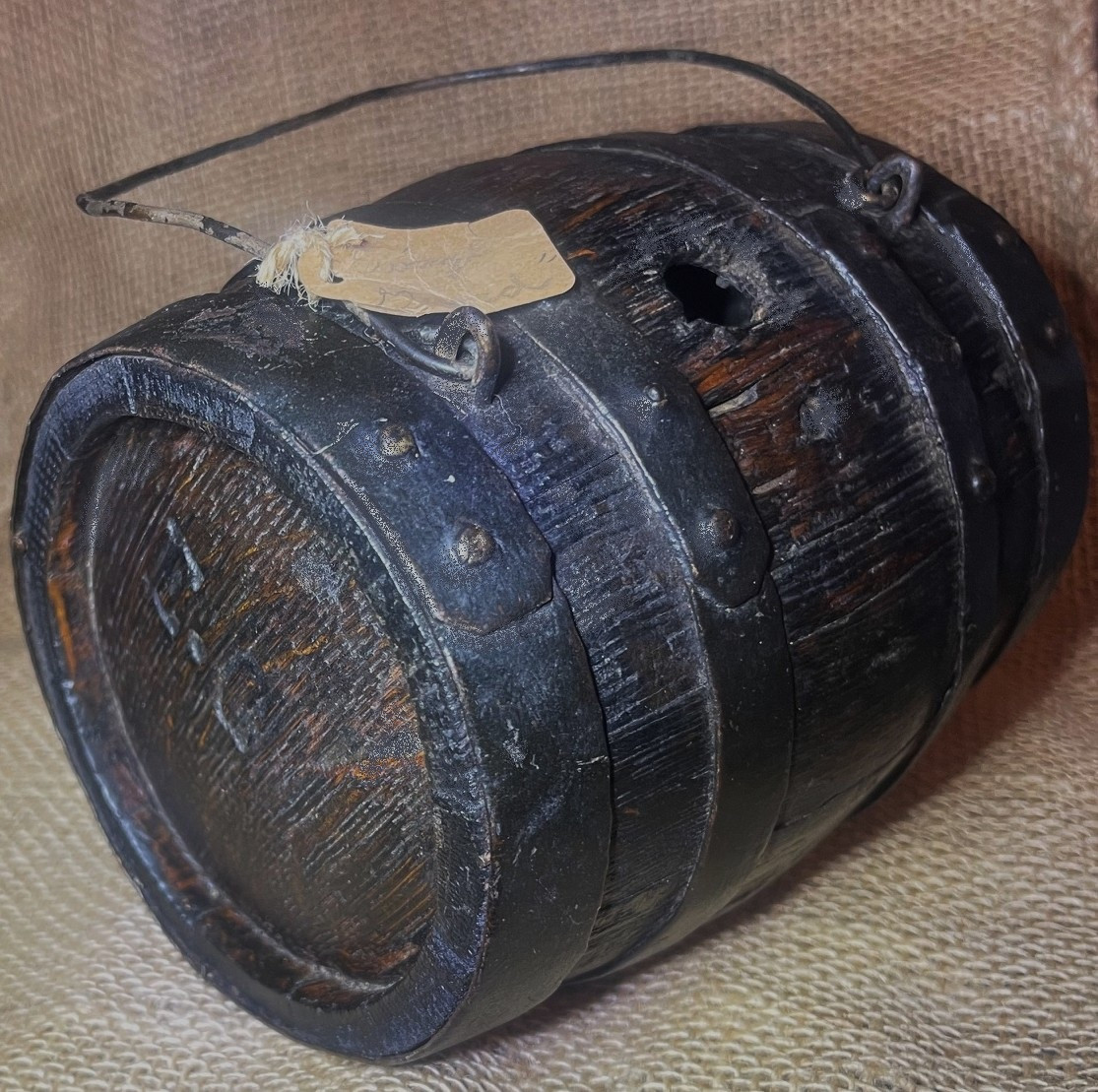
This is another nice piece being offered, it is a Revolutionary War Military staved Wooden Water Keg (Canteen) from the New Jersey / Pennsylvania area. It measures 5 1/2” long and the ends have a diameter of 4 1/2”. It has a staved construction held together with four metal bands. There is a ½” diameter fill-hole and a bale-wire carrying handle. Deeply stamped into each end is “E.G” for “Ewing’s Guard”.
Revolutionary War Era Army and/or Militia Soldiers would be required to bring a portable water canteen when reporting for duty. There is a “caricature drawing” done in 1777 of a Revolutionary War soldier carrying a similar keg (see pictures).
"Ewing's Guard" refers to the forces under Brigadier General James Ewing, who commanded a brigade of Pennsylvania militia in late 1776, guarding the Delaware River and participating in key winter campaigns. They were instrumental in patrolling and raiding against Hessian forces around Trenton before the pivotal Christmas 1776 crossing.
James Ewing was born in Lancaster County, Pennsylvania, the son of Thomas Ewing and Susanna Howard. His Scotch-Irish father served in the Pennsylvania Assembly during James’ boyhood. James would marry Patience Wright. As a young man, James Ewing was a part of General Edward Braddock’s 1755 expedition and then, in 1758, served as a lieutenant in the Pennsylvania militia.
Because of his military experience and support for independence, Ewing was commissioned as a brigadier general in the Pennsylvania militia on the fourth of July 1776. His brigade guarded the Pennsylvania side of the Delaware River when Washington’s forces crossed the Delaware on Christmas night 1776 (see pictures).
This canteen is in nice condition for its age and very solid. I discuss these early canteens in my book “The Civil War Canteen – Third Edition”. In the “Collector’s Illustrated Encyclopedia of the American Revolution”, by Neumann & Kravic, there are similar examples of this canteen (see pictures).
Revolutionary War artifacts have always been difficult to find, and I am fortunate to have quite a few pieces in stock. With the upcoming of the 250th anniversary of the nation's founding next year, there will be a revitalized interest. Just about all Revolutionary War relics and artifacts will be in demand, which will only add to their scarcity and price. I am already seeing a substantial increase in purchases.
Product Reviews
)